Peter Calthorpe on China’s “new urban agenda”

12796993395_24814a0bdf_b
Auto-based sprawl development, following Le Corbusier’s model of the “Towers in the Park.” Photo by John Patrick Robichaud, Wikimedia Commons

Cities have evolved for thousands of years, and they have a historic wisdom that we are collectively relearning. It’s a big change for China, though, because it’s been using an outmoded planning paradigm developed in the ’30s by the modernists—“Towers in the Park.” That paradigm failed us in many Western cities, and it is failing them now. – Peter Calthorpe


The architect, urbanist, and member of the UN panel selected to review the implementation of the New Urban Agenda, describes the dramatic changes in China’s urban development policies, foreshadowing some of the policies outlined in the UN’s New Urban Agenda  document. He is speaking to Dina ElBoghdady, a former reporter for the Washington Post, writing in Urban Land magazine.  An excerpt:

Q: What does the typical Chinese city look like today, and how did it evolve?

Before the 20th century, the traditional Chinese city was a fine-grained fabric of courtyard housing and small streets. But through the 1950s and 1960s, just after the Revolution, the Le Corbusier modernist tradition took hold and gave rise to the “superblock.” Initially, the superblock was a mixed-use community, about a quarter mile [0.4 km] on each side, with factories, housing, shops, and schools. As the factories grew larger, they became segregated from their communities, and housing became segregated from employment areas. Superblocks soon had isolated uses.

Q: How did these isolated uses affect the quality of city life?

As this new pattern of development accelerated and wealth accelerated, cars came to dominate the ever-larger streets, making them less pedestrian-friendly. People would have to walk a quarter mile to get to intersections, and once they got there, they’d have to cross eight or ten lanes of traffic. Mortality rates for pedestrians and bikers shot up. The less hospitable the streets became, the more people wanted to retreat from the street and live in gated communities, which brings us to where they are today…

Q: How have you helped shape the discussion on sustainable urban growth in China?

About six years ago, the Energy Foundation [a grant-making organization with a big presence in Beijing that focuses on climate change issues] asked us and other designers such as Jan Gehl to do pilot projects to demonstrate that there’s a better way than superblocks and highways for China’s cities. We’ve now worked in seven cities on plans for a population of 4 million, and we’ve done two large-scale regional plans that frame development for another 13 million people. Most of the work was for areas that were designated for growth. We laid out the blocks and streets, detailed the street sections, and zoned all the land for mixed use and TOD. And in each case it worked.

Q: Are these plans a reality yet?

They’re in the midst of being built. These were untested ideas for China. A lot of people six years ago said, “You’ll never undo the superblock. It’s an important part of the culture of modern China.” But being able to work with cities and developers, we found there are ways to create a transition, and the government saw that it was feasible and desirable. In addition to deadly air pollution and congestion, there’s the climate change factor. They are scientific realists over there, and they understand that livable cities will reduce carbon emissions and that renewable energy will be a big business that provides lots of jobs.

Q: Were you expecting the government to release new standards, let alone ones that are so in sync with your thinking?

I didn’t expect it, to tell you the truth. This is really a sweeping vision for how to change the direction of urban development in China. I thought they’d move along with piecemeal standards, some for roads, [some] for regulatory plans, and so on. I did not expect this grand, almost philosophical statement. I’ve been surprised at how quickly the government moved, and I’d like to believe that our work helped influence their thinking. Many of their standards correspond to the ones we’ve been advocating and testing. But most of the influence is from within—there have been many hands on this.

Q: Was there a tipping point for the Chinese government?

I think they realize that the cities have reached a crisis point. First, there’s the air quality. The cities are dangerously smoggy. Second, the traffic congestion threatens to compromise the economy as it becomes more difficult to move people and goods and services around. Third, China is committed to reducing carbon emissions. When you solve for livability—moving away from cars and toward transit and biking, integrating jobs and housing closer to one another, having mixed-use communities where a person’s trips and services are nearby—you reduce carbon emissions. Significantly, China imports most of its oil. The more auto-dependent they are, the more they are dependent on foreign oil, so that’s another motivator.

Q: Are these standards mandatory, and how long will it be until the effects are seen?

There are measurable elements that will become mandatory. For example, it quantifies the street density [and] the distance to transit, and requires that 40 percent of all trips in a city are made by transit. This really controls how investments are made in major infrastructure—roads versus transit. The effects are already being seen in the sense that planning departments and designers are adopting these ideas.

Q: Will the standards be applied to all Chinese cities?

They will. In China, they often write different standards for different-scale cities, and they scale the cities to three sizes. It’s a good way to do it because Beijing, for instance, is very different than a small third-tier emerging city. The high-level government group that released these standards is saying, “Here are the principles and direction we want to set.” Their departments of transportation and housing and urban development and other regulators are all going to have to do updates to their standards as a result of this.

Q: Many of these standards are in place in other countries. Why do you view them as a dramatic change in China?

The new standards do read like a list of ecological best practices that have developed around the globe. Cities have evolved for thousands of years, and they have a historic wisdom that we are collectively relearning. It’s a big change for China, though, because it’s been using an outmoded planning paradigm developed in the ’30s by the modernists—“Towers in the Park.” That paradigm failed us in many Western cities and it is failing them now. The problem is the scale of city building in China is so large that a failure will impact not only the viability of their cities, it could decimate the global economy and ecology.

Q: The government is calling for architecture that preserves Chinese culture—an apparent about-face from the radical designs seen in cities like Beijing. What brought about this change in mentality?

They’ve come to realize that they’ve been destroying their identity and cultural continuity as well as the environment. In a way, we did the same thing in the U.S. when urban renewal gutted our cities in the ’50s and ’60s. We didn’t have historic preservation laws. Piece by piece, great historic buildings came down. In China, the superstar architecture world was wreaking havoc with buildings that looked like they were flown in from outer space. Now, the government is saying [to] focus more on durability, function, and energy efficiency. To modern architects it is controversial, ambiguous, and challenging—to find an architecture that relates to place and climate rather than image.

Q: Do you consider yourself an antimodernist?

I am for modern architecture, but I want it to be historically, culturally, and environmentally connected to its place. The construction quality and materials in China are such that buildings barely last 30 years. The government is now basically saying, “Let’s make buildings that stand the test of time.”

Full interview: https://urbanland.uli.org/industry-sectors/infrastructure-transit/ul-interview-peter-calthorpe/
 

Co-founder of “New Urbanism” appointed to key panel for implementation of the UN’s “New Urban Agenda”

Peter_CalthorpeArchitect Peter Calthorpe, a co-founder of the Congress for the New Urbanism (CNU), has been appointed to an 8-member panel to review the direction of UN-Habitat following completion of Habitat III in October 2016 and its outcome document, the “New Urban Agenda.” This document was adopted by consensus in December 2016 by all governments of the United Nations General Assembly. Some critics of New Urbanism are likely to be displeased by this news, since it seems to formalize the “New Urbanist” aspects of the “New Urban Agenda.”
Indeed, the New Urban Agenda does feature many references to characteristics that are well known within New Urbanism, and incorporated into its foundational document, its “Charter of the New Urbanism.” Like the Charter, the New Urban Agenda calls for “appropriate compactness and density, polycentrism and mixed uses,” “connectivity,” “considering the human scale, and measures that allow for the best possible commercial use of street-level floors,” “bringing people into public spaces and promoting walkability and cycling,” and “equitable ‘transit-oriented development’ that minimizes the displacement, in particular, of the poor, and featur[ing] affordable, mixed-income housing and a mix of jobs and services.”

Perhaps the most notable feature of the New Urban Agenda is its frequent reference to public spaces and their character, including a call for “well-designed networks of safe, accessible, green and quality streets and other public spaces.” This has been a key point of focus for the Future of Places, a partnership that has included UN-Habitat as well as Project for Public Spaces and Ax:son Johnson Foundation, its NGO host (and the sponsor of this blog).

Why do some people criticize New Urbanism, sometimes vociferously? I suggest that some of the criticism is justified, some not. The justified criticism is aimed at aspirations unmet, promises unfilled, theory and practice that are incomplete at best, and rationalizations for bad development at worst. Some of this criticism is internal among members of the movement, and as I myself have witnessed, it can be passionate. That’s a healthy sign, surely.

The unjustified criticism comes chiefly in three varieties. One is from a “market fundamentalist” perspective, imagining that whatever a market decides is automatically the best for society, and for the planet. For this group, New Urbanism is hopelessly aligned with government planning efforts. These folks fail to recognize that “government planning efforts” created the conditions under which the market makes its decisions in the first place, and the “totally free market” is a myth of the most delusional sort. Ergo we must make reforms to this same government system, coupled with non-governmental activism (in professional, NGO, and private spheres) to achieve a more effective “polycentric governance” that combines the best of top-down planning frameworks and resources with the best of bottom-up organic growth. History shows us that this is precisely how the most successful and well-loved cities have also grown.

The second variety of criticism comes from the leadership of the profession of architecture, for whom the ultimate mandate is artistic creativity. For them, New Urbanism commits the unpardonable sin of daring to learn from history, and to recapitulate its lessons in both process and (egad) form. They may find revivalist forms distasteful, but it is the New Urbanists who are on the more solid theoretical ground, scientifically speaking. (And perhaps too speaking of professional responsibility to client well-being.) Evolution — including human evolution, and technological evolution — is not a constant reinvention from scratch, but a kind of fugue of recapitulations combined with novelty, and built up over time. At this critical point in our history, we must do a better job of looking for successes wherever we can find them – including in our own evolutionary past.

The third variety of criticism comes from the social sciences, where it is common to see attacks on the alleged “neoliberal politics” of New Urbanism. With this alleged sin comes gentrification, exclusion, homogenization, income inequality, and worse. But this image is largely a fantasy. While a few New Urbanists do in fact endorse neoliberal economic policies, the core of New Urbanist theory is based on Jane Jacobs’ very different work on diversity, openness, and a well-connected, fluid city. It argues that playing “whack-a-mole” with equity issues (or playing “PC solidarity” from our quixotic ivory towers) is less effective than actually changing the underlying structural conditions for self-organization, civic stewardship and urban justice – including the physical structure of the city. New Urbanists, for all their faults, have actually marched into battle on that score – and that may be a key part of the reason their ideas are now seen as a way forward for the New Urban Agenda.

Perhaps what both critics and supporters of New Urbanism should do at this point is to look beyond the branding, the schools and the identities, and toward larger shareable ideas and their implementation. The New Urban Agenda comes at a time when rapid urbanization presents enormous dangers to humanity – but at the same time, enormous promise, if we can learn from evidence and history.

Toward a Theory of “Place Networks”

FIGURE SIX
A “place network” of the public and private spaces on a typical street in London.

As we’re thinking about the qualities of public spaces — how they work, how they fail, how we can improve them — it’s critical to understand what happens at their edges, and within the web of complex relationships they have between their different public and private parts.

If we look at the human environment as a whole, we can readily see that many structures and processes are operating and interacting simultaneously across a range of scales – some with pronounced effects, some with subtle ones. This complex symphony in turn shapes the interactions, behaviors and experiences of human beings. What happens within the particular network of public spaces is particularly important (and therefore that is a particular focus of our center).

A number of well-developed theoretical systems have been able to model important aspects of this complex structural process: Graph Theory, Space Syntax, Pattern Languages, Multiple Centrality Assessment, and others. Other less well-developed frameworks suggest additional important aspects, including certain schools of environmental psychology, the young field of biophilia, and the “organized complexity” (and related insights) of theorist Jane Jacobs.

But we believe the theoretical picture presented by these different systems is incomplete and spotty, and there is no clear, unified, normative guidance presented to practitioners. This lacuna is particularly important in light of the challenges of sustainability and resilience, and the egregious failure of modern practices to respond in what can be regarded as plausibly adequate to these challenges.

As Kevin Lynch argued, we need a “theory of good city form,” if for no other reason than to make clear our assumptions and values. This line of thinking suggests that there is a need to unify these somewhat disparate and incomplete theoretical models, into a kind of “unified theory of spatial structure.” Such a model would give an over-arching explanation of these structural relationships across scales, and moreover, offer a general explanation of their dynamics of formation and human interaction. This in turn could serve as a badly needed guide to best practice in design, conceived now as a broader project that re-engages its humane responsibilities.

We believe the elements of such a “unified theory” do exist, provided by the partial theoretical systems mentioned above — but that they need to be assembled into a more integrated picture. Such a picture – which we term “Place Network Theory” for reasons we will explain below – might have the following key elements:

  1. Ability to generally describe the linked and fine-grained structure of urbanism across scales, from regional to neighborhood to street to building to small details and textures
  2. Ability to account for the phenomenological aspects of place, as structural and geometric phenomena.
  3. Ability to explain how such structures arise through the interactions of human beings with their environments, as processes evolving through time.
  4. Ability to explain the crucial syntax of public to private space, its capacity for modulation by users, and its role in modulating levels of interaction.
  5. Ability to account for the experiences of layering and sequence, and their importance.
  6. Ability to account for biophilic phenomena, such as the psychological benefits of plants, water, animals, and other biological geometries.
  7. Ability to account for the desirable and “livable” qualities of place.
  8. Ability to account for the capacity of urban spatial networks to facilitate economic interactions, following power laws and other related network phenomena.
  9. Ability to account for the capacity of urban spatial networks to reduce per-capita resource use, while still delivering a high quality of life
  10. Ability to analyze failing spaces, and create models of the failures with diagnostic value. (Especially the ubiquitous failures of modern environments.)

Such a theoretical picture may seem a very tall order, but as suggested, is already outlined by the insights already developed. It is above all a network model, mapping the connections between spaces within the built environments as room-like entities, with clear centers, edges and modulated boundaries. (Christopher Alexander has developed a very similar picture with his theory of “centers,” which, combined with patterns, do provide the strong outlines of such a Place Network Theory.)

As we see it, this “place network theory,” then, would combine the following elements:

  1. An understanding of the working units of space as room-like structures or “places” with membrane-like boundaries affording connections to one another (though they may be very small, or conversely, very large).
  2. An understanding of the network connections of these places (hence “place networks”), consisting of hierarchical aspects (lower units are constituents of upper units) as well as overlapping aspects.
  3. An understanding of the processes of their forming and transforming, and how certain rule-based actions govern these.
  4. An understanding of the tendency of “attractors” or “patterns” to form (relatively stable configurations that are repeated as solutions or resolutions to problems or conflicts).
  5. An understanding of the evolutionary system that is generated by this pattern-forming process, and its ability to build greater problem-solving capacity over time, and greater complexity and beauty (and these are related, as they are in biological systems).
Screen Shot 2017-04-02 at 4.40.13 PM
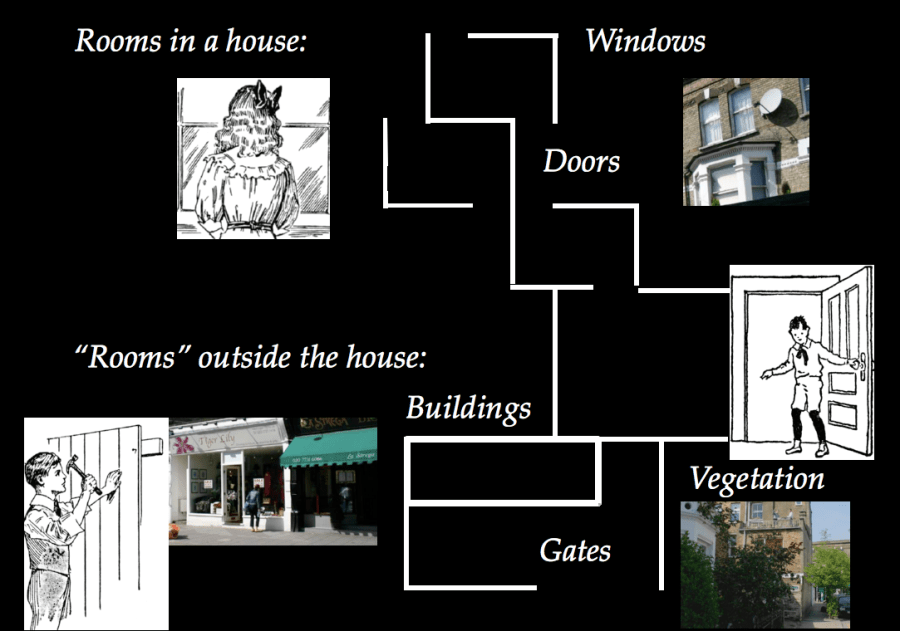
We can think of the “places” in a “place network theory” as room-like spaces, stretching from literal rooms in the most private parts of a house, to the much more public room-like places within public space.

We spoke of the need for “normative guidance.” What guidance would such a theoretical picture offer? We suggest the following:

  1. Urban structures (buildings, streets, landscapes etc.) must provide for users to make ready adaptations across a range of scales, so as to control their own degrees of interaction. (Simple examples are doors, windows, curtains, gates, etc – but more permanent alterations must be possible too). This is the basis of urban self-organization, a critical capacity for ecological resilience.
  2. Related to this, patterns of spatial activity must provide an essential framework of space, with a gradient from public to private, and a modulated, self-organizing system of connections across this gradient.
  3. Following this, urban structures need to be easily repairable and adaptable to new uses, with the involvement of local participants in the economy, and local (renewable) resources.
  4. Related to this, urban structures must be seen as tools for the generation of local and sustainable economic activity, and the relation of economic vitality to sustainability must be codified and reinforced within a range of economic and planning tools.
  5. Related to this, the repositories of previously evolved urban structures, and also patterns of natural structure with important capacities for human beings (patterns, prototypes, design motifs, etc) are essential sources of genetic material.
    Therefore, patterns of spatial activity must be conserved for later learning and re-adaptation. Precedent must not be rejected in the name of artistic novelty. This is at present a serious, even catastrophic failing of modern design instruction.

Such a unified theory is therefore urgently needed, in view of the ongoing failures of far too much work in the environmental planning, design and building professions today. As the saying goes, “Rome burns.”

Screen Shot 2017-04-02 at 4.40.17 PM
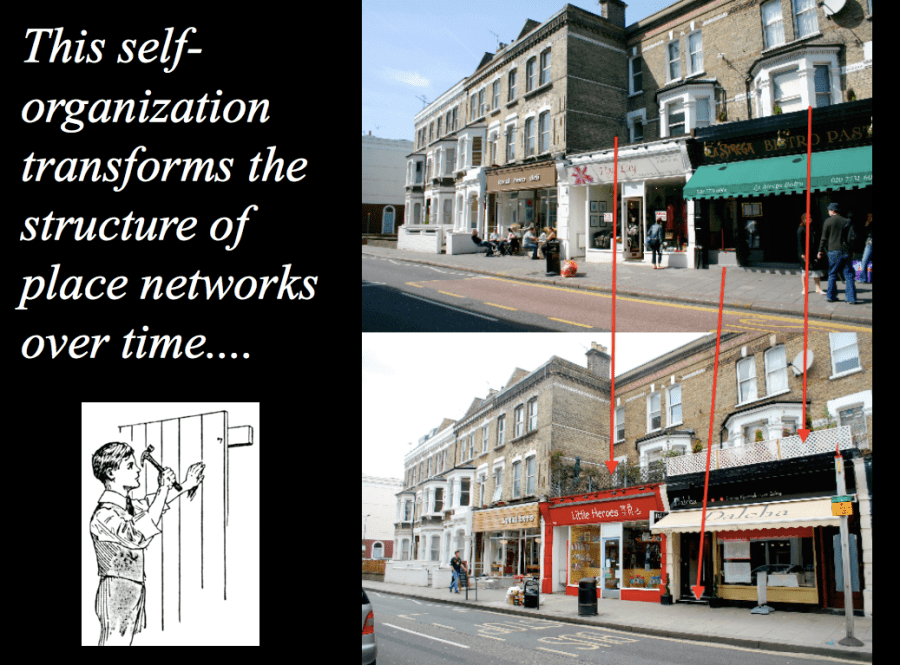
An example of a transformation over time, showing the same place illustrated in the photo at the top of this post, after five years of subtle changes to its “place network”
Screen Shot 2017-04-02 at 4.40.20 PM
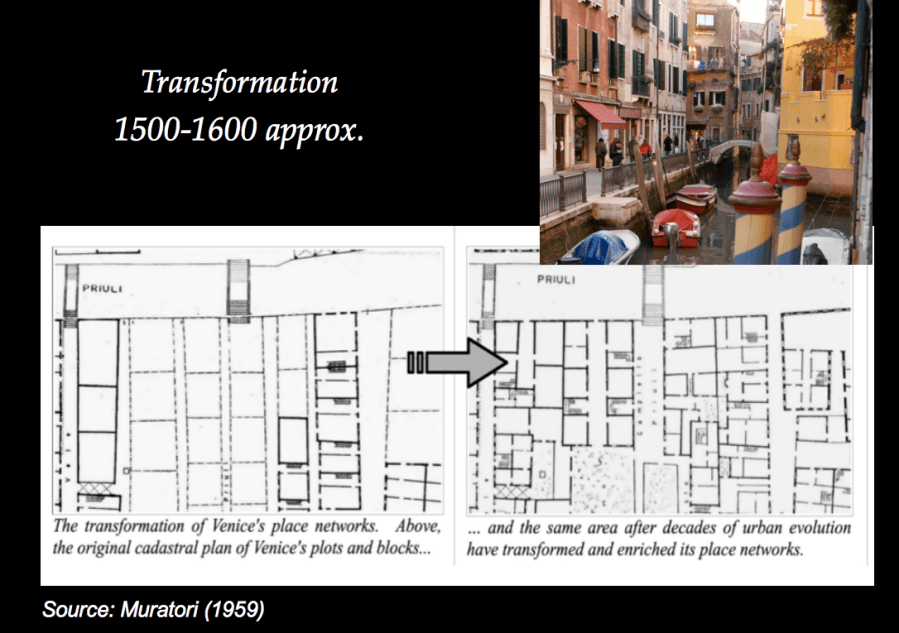
A more dramatic transformation of the “place networks” of Venice, over more than 100 years.
defective_place_networks-scaled-1000
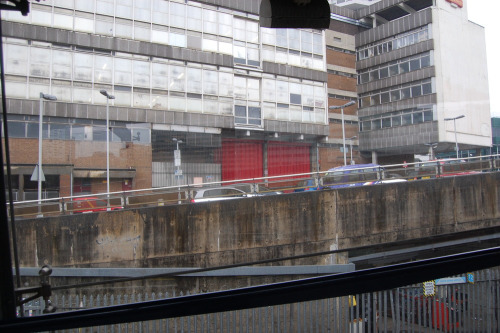
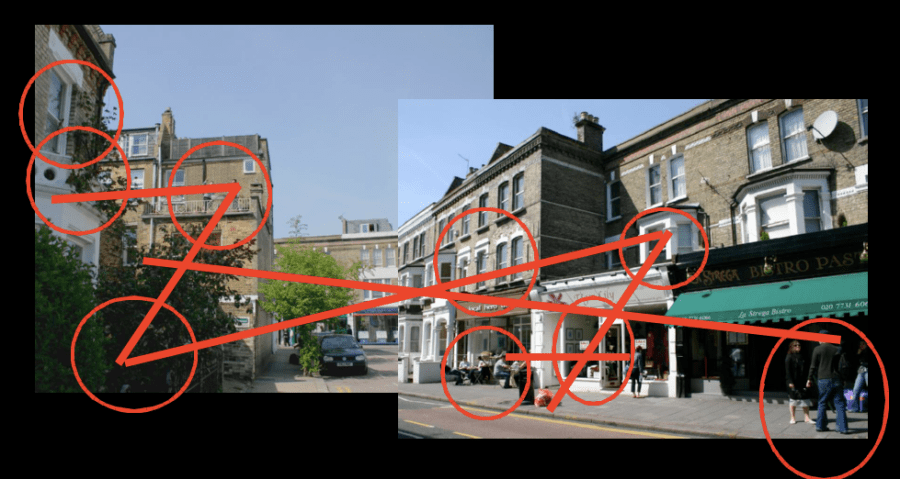
A very poorly articulated place network in London.
Screen Shot 2017-04-02 at 4.41.16 PM
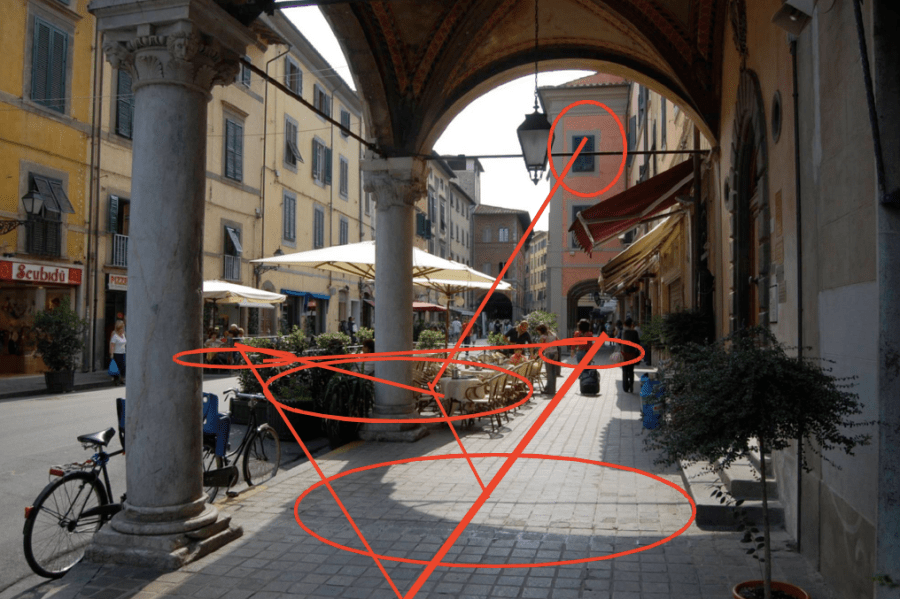
A much more richly articulated place network in Pisa, Italy. Note the relationships to private spaces, and the network’s function within three dimensions. 

New insights from an emerging “Science of Cities”

In the past few years, a remarkable body of scientific research has begun to shed new light on the dynamic behavior of cities, carrying important implications for city-makers. Researchers at cutting-edge hubs of urban theory like the University College London and the Santa Fe Institute have been homing in on some key properties of urban systems—and contradicting much of today’s orthodoxy. Their findings have begun to feed into recent and upcoming gatherings on the future of cities—including lead-in events for the U.N.’s big 2016 Habitat III conference on sustainable development—and arming leaders in the field with new ammunition in the global battle against sprawl.

In one sense, these lessons are not so new. Legendary urbanist Jane Jacobs was famous for her prescient insights about the emerging sciences of “organized complexity” and what they offered for a more effective approach to urban planning—insights she published all the way back in 1961. (In fact, physicist Geoffrey West of the Santa Fe Institute likes to say they are just doing “Jacobs with the math.”)

Jacobs was also famous for excoriating the backward-looking “pseudo-science” of that era’s planning and architecture, which she said seemed “almost neurotic in its determination to imitate empiric failure and ignore empiric success.” She urged city-makers to understand the real “kind of problem a city is”—not a conventional problem of top-down mechanical or visual order, but a complex problem of interacting factors that are “interrelated into an organic whole.” She urged planners and architects to show greater respect for the intrinsic order of cities, and to apply the best insights of the new sciences, coupled with the most pragmatic methods.

Today, in an age of rapid urbanization and growing urban challenges, that advice could not be more timely. In many ways, the new findings confirm and extend Jacobs’ original insights. Here are five of the most significant:

Cities generate economic growth through networks of proximity, casual encounters and “economic spillovers.” The phenomenal creativity and prosperity of cities like New York is now understood as a dynamic interaction between web-like networks of individuals who exchange knowledge and information about creative ideas and opportunities. Many of these interactions are casual, and occur in networks of public and semi-public spaces—the urban web of sidewalks, plazas, and cafes. More formal and electronic connections supplement, but do not replace, this primary network of spatial exchange.

Through a similar dynamic, cities generate a remarkably large “green dividend.” It has long been known that cities have dramatically lower energy and resource consumption as well as greenhouse gas emissions per capita, relative to other kinds of settlements. Only some of this efficiency can be explained by more efficient transportation. It now appears that a similar network dynamic provides a synergistic effect for resource use and emissions—what have been called “resource spillovers.” Research is continuing in this promising field.

Cities perform best economically and environmentally when they feature pervasive human-scale connectivity. Like any network, cities benefit geometrically from their number of functional interconnections. To the extent that some urban populations are excluded or isolated, a city will under-perform economically and environmentally. Similarly, to the extent that the city’s urban fabric is fragmented, car-dependent or otherwise restrictive of casual encounters and spillovers, that city will under-perform—or require an unsustainable injection of resources to compensate. As Jacobs said, lowly appearing encounters on sidewalks and in other public spaces are the “small change” by which the wealth of a city grows.

Cities perform best when they adapt to human psychological dynamics and patterns of activity. Urban residents have a basic need to make sense of their environments, and to find meaning and value in them. But this issue is not as straightforward as it may appear. Research in environmental psychology, public health and other fields suggests that some common attributes promote the capacity to meet these human requirements—among them green vegetation, layering, and coherent grouping. Wayfinding and identity are also promoted by iconic structures, and meaning is enriched by art. But for most people most of the time, evolutionary psychology is a more immediate factor to be accommodated. As Jacobs cautioned, a city is not primarily a work of art. That way of thinking is bad for cities—and probably bad for art too.

Cities perform best when they offer some control of spatial structure to residents. We all need varying degrees of public and private space, and we need to control those variations at different times of the day, and over the span of our lives. In the shortest time frames, we can open or close windows and doors, draw blinds, come out onto porches and informally colonize public spaces, or retreat inside the privacy of our homes. Over longer time frames, we can remodel our spaces, open businesses, build buildings, and make other alterations that gradually form the complex dynamic growth of cities.

These examples illustrate that cities are complex adaptive systems with their own characteristic dynamics, and—if they are going to perform well from a human point of view—they need to be dealt with as such. In that light we must re-assess our current systems of planning, building and managing cities—the laws, codes, standards, models, incentives, and disincentives that effectively make up the “operating system” for urban growth. To make better cities, we need to shift to an evidence-based approach, able to draw on the best lessons of science and history about the making of good cities, from a human point of view.

But this is far from conventional urban practice, which too often features an art-dominated approach to architecture that values novel visual imagery over enduring human city-making. At its worst, this approach is little more than a kind of marketing package over a still-prevailing mechanical approach to cities: a focus on objects, a promotion of segregated campuses, superblocks, and malls, and an over-reliance on isolating, high-resource consumption systems like personal automobile transportation. These negative practices are still alarmingly commonplace in rapidly urbanizing parts of the developing world today.

The stakes for reform could not be higher. Over the next five decades, if present trends do not reverse dramatically, humanity is set to create more sheer volume of urban settlement than it has in the entire previous history of human settlement. The implications are nothing short of alarming for the Earth’s ecology, for the viability of future economies, and for the future quality of human life. We desperately need tools to understand the likely effects, and to guide us in making the changes needed—professionally, politically and economically—to avert future catastrophe.

It seems that humanity now faces a watershed challenge: to find a new basis to generate creative economies and quality of life, without destroying the resources on which life ultimately depends. If we do not do so, we are likely to enter an era of unprecedented human misery. In this challenge, cities will be enormous contributors to the problem. Or, if we understand the lessons from the emerging science of cities about cities’ dynamic capacity to promote creative growth while reducing resource destruction—and perhaps even offering the promise of regeneration—they can be enormous contributors to the solution.

A version of this post also appeared on the CityLab website.


Public space in the New Urban Agenda:

The Road to Implementation

h3
The New Urban Agenda is debated in Quito, Ecuador in October 2016

The New Urban Agenda is now the official policy of the United Nations, adopted by a vote of all member states at the UN General Assembly in December 2016. We are gratified that the Future of Places forum has contributed to the content of the Agenda, and in particular the key elements that deal with public space. The New Urban Agenda rightly recognizes the fundamental role of public spaces as “drivers of social and economic development,” “enhancing safety and security, favoring social and inter-generational interaction and the appreciation of diversity” as well as “promoting walkability and cycling towards improving health and well-being.” As Habitat III Secretary-General Joan Clos observed, a city without public spaces is not really a city at all.

And yet we continue to build just such non-cities, sprawling across the globe in chaotic bursts of fragmented development. Sometimes they are informal settlements for the poor, lacking in adequate, safe and inclusive public spaces. Sometimes they are more expensive developments for the middle and upper classes, featuring privatized shopping malls, gated neighborhoods, and vast stretches of automobile-dominated, resource-intensive sprawl. Although these new developments do carry some positive benefits, especially the alleviation of the problems of poverty, evidence demonstrates that their negative impacts on social, economic and ecological sustainability will be profound.

What is lacking is an adequate evidence-based body to guide implementation of a more benign public space agenda. Research demonstrates that a healthy framework of public space impacts all the other aspects of urbanization, including social, economic and ecological benefits. But to achieve these benefits, we need to know how public space works, how it shapes behavior, how it produces positive outcomes for all parts of society, and what is needed to ensure those outcomes are achieved. We also need to understand the threats to public space – how it fails, how it declines, and what are the barriers to its creation and improvement over time.

This, broadly speaking, is the research agenda of the Future of Places Research Network. We are a network of institutions and researchers, with our main hub at KTH Royal Institute of Technology in Stockholm. We follow the model of a “research coordination network” – that is, we all work on a range of projects including joint projects, smaller group projects, and individual projects at our own institutions.

All of us have participated in the Future of Places forum, a three-year conference series that brought together over 1,500 researchers, practitioners, officials and activists, representing more than 700 organizations, 275 cities and 100 countries from all around the world.

The most important joint project we have currently is DaRPS, the Database on Research in Public Space. This database compiles key field research literature on public space – a surprisingly incomplete subject area, given its importance – and identifies key findings as well as key gaps in the research that can be addressed by members of our research network. From there we will disseminate key conclusions and tools for implementation through white papers, books, symposia, and other forms of communication. We will also participate in implementation projects for the New Urban Agenda, where we can conduct research that adds to the knowledge base in general, and the database in particular.

We are excited by the work ahead, and we look forward to staying in touch with you and your colleagues as this work develops!